Getting Started with Markdown in VSCode
The following are some markdown examples of what you might use when adding/editing the ReEDS documentation. The following are some additional resources:
General Markdown: https://www.markdownguide.org/cheat-sheet/
Math notation in markdown: https://www.upyesp.org/posts/makrdown-vscode-math-notation/
Tables
Markdown Syntax: to insert table
    ```{table} UPV and DUPV Resource Classes
    :name: upv-dupv-resource-classes

    |  Class  | GHI (kWh/m^2/day) | Potential UPV Capacity (GW) | Potential DUPV Capacity (GW) |
    |---------|-------------------|-----------------------------|------------------------------|
    |      1  |          3.0 - 3.5|                          167|                            14|
    |      2  |          3.5 - 4.0|                       16,870|                           184|
    |      3  |          4.0 - 4.5|                       30,238|                           434|
    |      4  |          4.5 - 5.0|                       37,438|                           511|
    |      5  |          5.0 - 5.5|                       20,372|                           222|
    |      6  |          5.5 - 6.0|                       11,868|                           116|
    |      7  |          6.0 - 6.5|                          332|                             4|

    ```
Output
Class |
GHI (kWh/m^2/day) |
Potential UPV Capacity (GW) |
Potential DUPV Capacity (GW) |
|---|---|---|---|
1 |
3.0 - 3.5 |
167 |
14 |
2 |
3.5 - 4.0 |
16,870 |
184 |
3 |
4.0 - 4.5 |
30,238 |
434 |
4 |
4.5 - 5.0 |
37,438 |
511 |
5 |
5.0 - 5.5 |
20,372 |
222 |
6 |
5.5 - 6.0 |
11,868 |
116 |
7 |
6.0 - 6.5 |
332 |
4 |
Markdown Syntax: to reference a table
To have a numbered reference (ex: ‘Table 1’)
{numref}`upv-dupv-resource-classes`
To have a non-numbered reference (ex: ‘UPV and DUPV Resource Classes’)
{ref}`upv-dupv-resource-classes`
Figures
Markdown Syntax: to insert figure
    ```{figure} figs/docs/csp-resource-availability.png
    :name: example-figure

    CSP resource availability and solar field capacity factor for the contiguous United States
    ```
Output
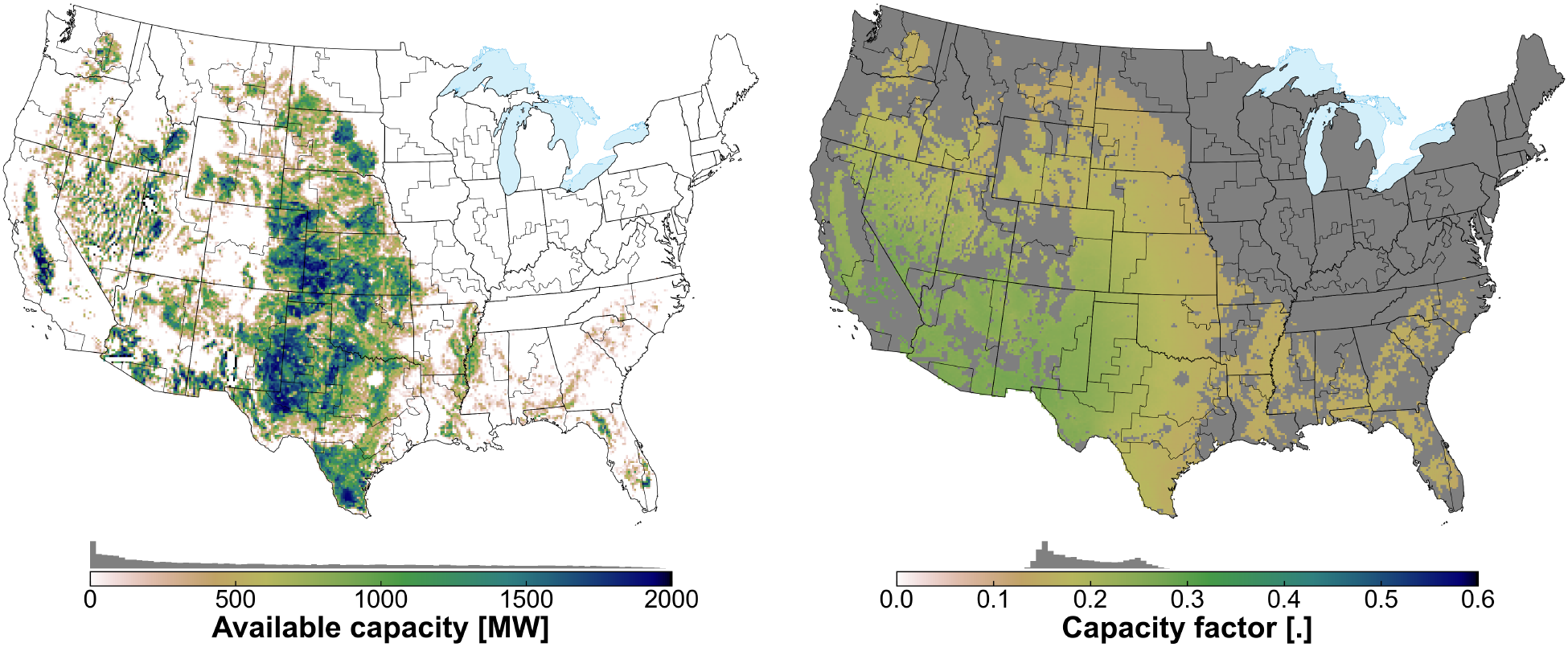
CSP Resource Availability
Markdown Syntax: to reference a figure
To have a numbered reference (ex: ‘Fig. 1’)
{numref}`figure-csp-resource-availability`
To have a non-numbered reference (ex: ‘CSP Resource Availability’)
{ref}`figure-csp-resource-availability`
Footnotes
To use footnotes in the documentation, follow this general structure.
Adding a new footnote:
[^ref68]: Older versions of the ReEDS model
         (version 2022 and earlier) included the full
        spatial dataset, and then subset the
        model equations to only include
        equations for the region of interest.
Referencing a footnote:
North Dakota.[^ref68]